It's been 10 years since my first surgery, and due to recent facial sagging, I’m looking into a secondary facelift.

"Hello. I am a woman in my mid-60s.
I had my first facelift 10 years ago at a different clinic. For the first few years, I received a lot of compliments about how refreshed I looked and was quite satisfied. However, over time, my cheeks have started to sag again, my jawline has become blurred, and that heavy, dropped look has returned. What bothers me the most is that one side of my cheek looks noticeably more saggy than the other, making my face look slightly crooked and causing a lot of stress whenever I take photos.
Recently, I’ve been doing some research online and came across the deep plane facelift, which lifts the deeper muscle layers of the face. It made me wonder if a revision facelift is what I need. However, because my face has already undergone surgery once before, I am terrified of things like, 'Is it even safe to get a secondary surgery?' or 'Will my facial expressions look stiff and unnatural?' These anxieties are holding me back from making a decision.
I would deeply appreciate it if Dr.Yoosuk Chung could give me his honest insights on the following three questions:
1) Is a deep plane revision facelift possible on someone who had a facelift a decade ago? What are the most critical anatomical factors or skin conditions that need to be evaluated before determining if a patient is a good candidate for a secondary surgery?
2) Can a secondary facelift fix facial asymmetry? My cheek volume and jawlines look uneven right now. To what extent can revision surgery correct this imbalance? I would love your candid medical opinion on whether expecting perfect symmetry is realistic.
3) What should I expect regarding facelift scars and downtime? Since this is a re-operation, scarring is my biggest fear. Do you typically cut along the previous facelift scar line, or will new scars be created? Also, what is the realistic revision facelift recovery time before I can comfortably return to work, social gatherings, and daily routines?
I would love to get your realistic advice based on your extensive clinical experience. Thank you, and I look forward to your reply!"
Comments 1
-
 정유석원장 작성일
Hello, this is Dr.Yoosuk Chung,
Over my 32-years career in facial rejuvenation and body contouring, I have performed a vast number of surgeries, including primary facelifts, deep plane facelifts, body lifts (tummy tucks, arm/thigh lifts), breast augmentations, rhinoplasty, blepharoplasty, and breast reductions. Let me address your concerns regarding a revision facelift step by step.
(Question)
1. Is a Deep Plane Revision Facelift Possible 10 Years After a Primary Facelift?
(Answer)
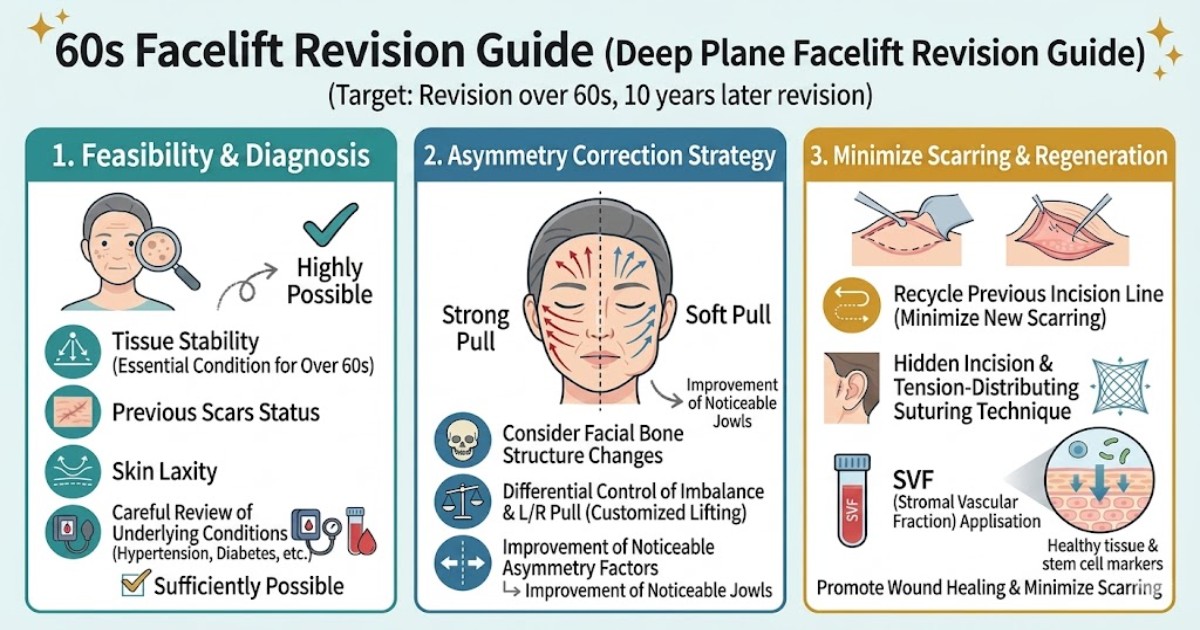
For patients in their mid-60s seeking a secondary facelift, tissue stability and healing capacity are paramount. If you meet the medical criteria, a revision surgery is absolutely possible.
Before moving forward, we thoroughly evaluate key anatomical factors, including:
Your previous facelift scars and remaining skin laxity.
The current severity of your jowls (sagging cheeks), neck sagging, and overall skin elasticity.
Any underlying medical conditions (such as hypertension or diabetes).
If you can bring your previous surgical records or post-op photos to your consultation, it will help us provide an even more precise diagnosis.
(Question)
2. Can a Secondary Facelift Correct Jowl Asymmetry?
(Answer)
The facial asymmetry you are currently noticing is likely a combination of three distinct factors:
Uneven tension or lifting during your initial surgery.
Asymmetric aging, where one side of the face naturally sags faster or more significantly over the decade.
Your inherent facial bone structure and muscle asymmetry.
Particularly in our 60s, age-related changes in the musculoskeletal structure can naturally worsen facial imbalances. In a revision facelift, our goal is not to achieve mathematically perfect symmetry, but rather to harmonize visible imbalances—such as uneven jowl height, the contour of the jawline, and the depth of the nasolabial folds (smile lines). Instead of pulling both sides with identical force, I tailor the lifting tension—applying a firmer lift where needed and a more flexible adjustment on the other side—to restore a natural balance while keeping new facelift scars to an absolute minimum.
(Question)
3. What About Revision Facelift Scars, Downtime, and Returning to Daily Life?
(Answer)
To address your biggest concern—scarring—we carefully trace and reuse your existing incision lines to ensure no unnecessary new scars are created. Our clinic utilizes a specialized "Hidden Incision" method that follows the natural, micro-contours of the ear, combined with an advanced tension-distribution suturing technique. Furthermore, we incorporate SVF (Stromal Vascular Fraction) during the procedure to accelerate wound healing and cellular tissue regeneration.
[The Recovery Process & Post-Op Guidelines]
Bruising: Typically lasts about 1 to 2 weeks, though this varies by individual. To prevent post-inflammatory hyperpigmentation, it is crucial to apply sunscreen diligently, extending it slightly beyond the bruised areas.
Swelling: Major swelling resolves gradually over 3 to 6 months. It is completely normal for the left and right sides to heal at slightly different rates, but this will balance out naturally over time.
Returning to Social Life: You can generally resume light outings and social gatherings within 3 to 4 weeks. Ample rest is essential during the first few days, and we recommend scheduling major social commitments or events at least 3 weeks post-op.
Daily Precautions: For the first month, avoid hard or chewy foods and try not to open your mouth excessively wide. This allows the deep facial tissues to anchor and settle securely into their new, lifted positions.
Because a secondary procedure involves navigating previously altered tissues, you may experience mild tightness or residual swelling slightly longer than you did during your first surgery. This is a completely normal and expected part of the deep plane healing process.
It is entirely natural to feel a mix of anxiety and excitement during your facelift recovery. Our job is to guide you comfortably through every step of this journey. If you have any questions—no matter how small—from pre-op planning to your final follow-up, please feel free to ask. We are fully committed to ensuring your safe, healthy, and beautiful transformation.
#DeepPlaneFacelift #RevisionFacelift #SecondaryFacelift #TheLinePlasticSurgery #DrYoosukChung ##FaceliftRecovery #FacialAsymmetry #NaturalFacelift #FaceliftScars #FacialRejuvenation