"Lost weight on Mounjaro but look older? Is a facelift the only fix for 'Mounjaro Face'?"

"I lost weight fast on Mounjaro and now my face is sagging and looks aged. Is a facelift my only option?"
Comments 1
-
 정유석원장 작성일
Hello, I am Dr.Yoosuk Chung, Chief Surgeon at The Line Plastic Surgery Clinic. Over the past 32 years, bridging the gap between facial contouring and body shaping, I have witnessed the transformations of over 100,000 patients. Recently, I have felt a deep sense of medical responsibility when patients who achieved rapid weight loss through GLP-1 injections like Mounjaro express profound disappointment, saying, "I lost the weight, but now my face looks saggy and aged." True weight loss is not just about the number on the scale; it is about maintaining a toned, youthful contour. Leveraging my 32 years of clinical expertise, I would like to provide clear, definitive answers to your most pressing questions.
(Question)
Q1: I lost weight rapidly on a Mounjaro diet, and now my face is sagging and looks much older. Is a facelift the only solution?
(Answer)
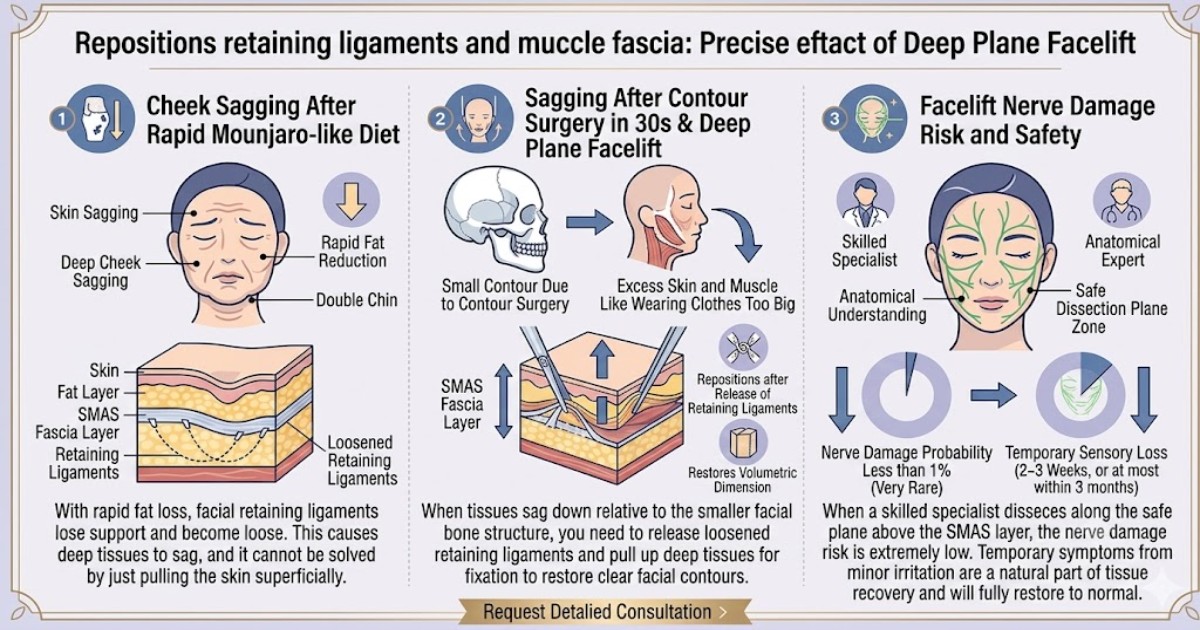
A: When you undergo rapid, massive weight loss using medications like Mounjaro, the retaining ligaments in the face slacken, leading to severe skin laxity—a phenomenon widely known as "Mounjaro Face." To fundamentally resolve this, a Deep Plane Facelift, which directly repositions the SMAS (Superficial Musculoaponeurotic System) layer and the underlying retaining ligaments, is the most effective and definitive solution.
Standard thread lifts or traditional mini facelifts offer limited results because they only pull the superficial skin layer. In contrast, the Deep Plane technique separates and corrects the deep structural tissues beneath the skin, delivering a powerful lifting effect that reverses rapid facial aging. Rather than simply excising excess skin, this advanced surgical strategy restores facial volume and medically corrects post-weight-loss elasticity loss by addressing the root cause in the deep tissue layers.
(Question)
Q2: I'm only in my 30s, but I have severe cheek sagging after facial contouring surgery (bone reduction). Is it okay to get a facelift at my age?
(Answer)
A: When the facial bone structure is reduced through contouring surgery, the remaining skin and muscle can sag downward—much like wearing clothes that are a few sizes too big. To fix this at its root, a facelift is highly recommended, even for patients in their 30s, to manually return the displaced tissues to their original positions.
Sagging caused by structural alterations in the skeleton—as opposed to natural, age-related skin elasticity loss—cannot be significantly improved with non-invasive laser lifting alone. It requires a surgical correction that releases the stretched retaining ligaments and elevates the deep tissues upward. By utilizing a 1:1 customized minimal incision approach tailored to the patient's tissue condition, we can minimize scarring while simultaneously lifting sagging jowls and sharpening the jawline. Addressing this early through a precise diagnosis with a board-certified surgeon is highly beneficial for long-term anti-aging.
(Question)
Q3: Is there a risk of facial nerve damage when undergoing a facelift?
(Answer)
A: Permanent facial nerve damage during a facelift is extremely rare. When performed by an experienced specialist who dissects along the safe anatomical planes above the SMAS layer, the risk of permanent injury is well under 1%, so you can rest assured.
During the procedure, microscopic stimulation of the nerves may cause temporary numbness or slightly awkward facial movements. This is a completely natural part of the tissue healing process. These symptoms typically resolve within 2 to 3 weeks, and in almost all cases, 100% full recovery is achieved within 3 months. The key to safety lies in the surgeon’s deep understanding of facial anatomy to precisely navigate around nerve pathways. Combined with a structured post-operative care program, a facelift is a highly recommended and safe procedure to restore elasticity while minimizing complications.
(Question)
Q4: How long will it take for facial expressions to feel natural and for stiffness when opening my mouth to subside after a facelift?
(Answer)
A: Difficulty opening the mouth and stiff or unnatural facial expressions after a facelift are temporary phenomena that occur during the tissue healing phase. These symptoms improve drastically within 2 to 3 weeks, and patients can return to completely natural daily life within 3 months at the latest.
During the precise repositioning of the SMAS layer and retaining ligaments, the facial nerves may experience minor, temporary irritation, which can briefly limit muscle movement. This is not nerve damage, but rather a normal phase of tissue stabilization. While individual recovery rates vary, major swelling typically subsides around day 14, at which point facial expressions begin to soften significantly. Following your surgeon's customized aftercare instructions will further accelerate your recovery and ensure optimal, natural-looking elasticity.
#MounjaroFace #DeepPlaneFacelift #FaceliftBeforeAndAfter #FacialContouringRecovery #SMASLifting #WeightLossSaggingSkin #FaceliftTimeline #AntiAgingSurgery #MedicalTourismKorea