What makes a deep plane facelift so different from a traditional facelift, and why does everyone say it lasts so much longer?

Q: How does a deep plane facelift differ from a standard facelift, and what gives it such superior longevity?
Comments 1
-
 정유석원장 작성일
Hello, I am Dr. Yoosuk Chung, Board-Certified Plastic Surgeon at The Line Plastic Surgery Clinic.
Whenever patients ask me, "Doctor, is it true that a facelift only lasts a year or two before sagging returns?" I always emphasize the absolute necessity of a deep plane facelift. While a traditional facelift focuses heavily on merely pulling the surface skin, a deep plane facelift targets the root cause of structural aging: the deep-layer retaining ligaments. Backed by 32 years of refined surgical mastery, I am proud to share the core principles of the deep plane facelift—a procedure designed to restore timeless, natural elegance that withstands the test of time.
(Question)
Q1. What makes a deep plane facelift so different from a traditional facelift, and why does it last so much longer?
(Answer)
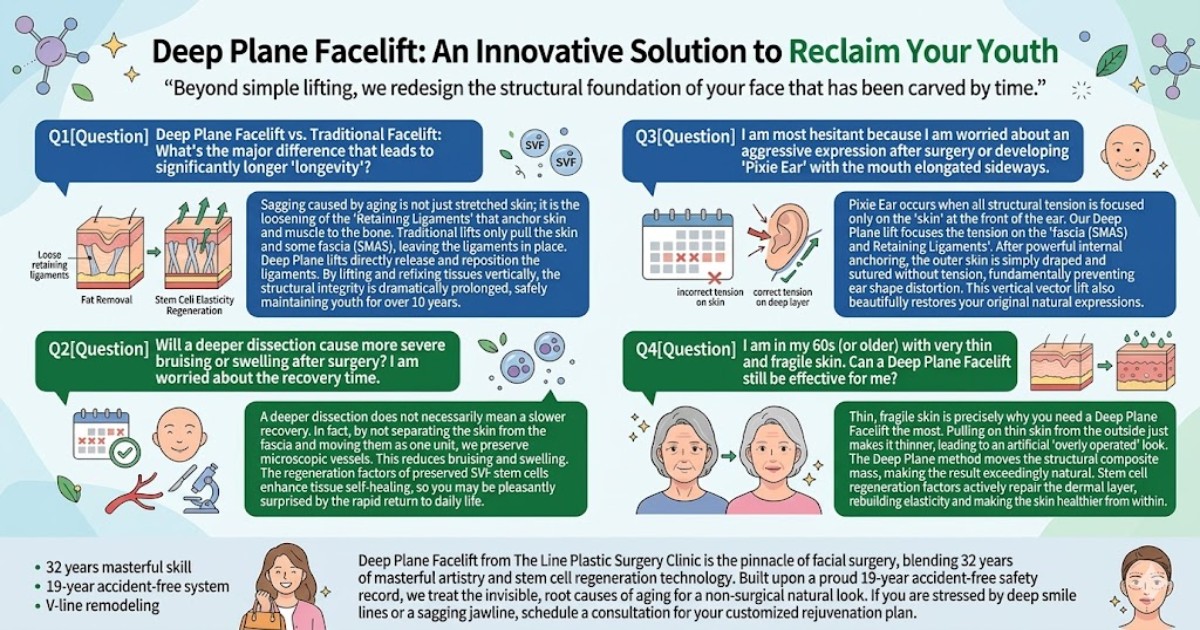
A1. Facial sagging happens not just because the surface skin stretches, but because the retaining ligaments—the structural bands that anchor your skin and muscle to the facial bone—loosen over time. A traditional facelift leaves these ligaments intact and only pulls the outer skin and a portion of the SMAS layer. Because of this, the tissue exerts a powerful downward pull, causing sagging to recur relatively quickly.
In contrast, the deep plane facelift I perform goes beneath the muscular layer to directly release and reposition these tight retaining ligaments. By freeing the "obstacles" that hold the sagging tissue in its aged position, the entire midface and jawline structure can be lifted vertically without tension. This dramatically amplifies the longevity of the facelift, allowing patients to safely maintain a youthful, refreshed appearance for 10 to 15 years or more.
(Question)
Q2. Because a deep plane facelift involves a deeper layer of dissection, will it cause severe swelling and bruising post-op? I’m very worried about the recovery time.
(Answer)
A2. A deeper dissection does not automatically mean a longer or more painful recovery. In fact, the deep plane technique moves the skin and the SMAS layer together as one cohesive unit without separating them. This naturally preserves the vital microscopic blood vessels beneath the skin.
Leveraging my 32 years of clinical expertise, I minimize intraoperative bleeding to the absolute limit. Furthermore, I integrate an advanced regenerative method where we discard the fat but preserve SVF (Stromal Vascular Fraction), which is highly rich in healthy stem cells, to supercharge the body’s natural tissue healing. These stem cell regenerative factors exert a powerful anti-inflammatory effect, drastically reducing post-operative pain, bruising, and swelling. As a result, patients enjoy a much faster recovery and a swift return to daily life compared to standard facelifts.
(Question)
Q3. My biggest hesitation about getting a facelift is the fear of looking artificial, having a tight, windswept mouth, or ending up with "pixie ears."
(Answer)
A3. An unnatural appearance or a deformed "pixie ear" occurs when a surgeon places all the pulling tension directly onto the skin closures near the ear.
With a deep plane facelift, however, the structural tension is completely shifted away from the skin and anchored deep within the SMAS layer and the released retaining ligaments. Once the heavy lifting is securely locked in internally, the surface skin is simply draped over gently and sutured without any tension. This fundamentally prevents earlobe distortion and pixie ears. Additionally, by utilizing a strict gravity-defying vertical vector lift, the mouth is never stretched sideways. Instead, the procedure beautifully restores your original, natural facial expressions from your youth.
(Question)
Q4. I am in my 60s (or older), and my skin is very thin and fragile. Can a deep plane facelift still be effective for me?
(Answer)
A4. Patients with thin, fragile skin actually need a deep plane facelift the most. If you perform a traditional surface-level facelift on thin skin, the skin becomes even thinner, resulting in an artificial, overly operated look.
Because the deep plane method repositions the entire composite mass of facial tissue as a whole rather than relying on skin thickness, the outcome is exceptionally natural. When combined with our SVF technology, the stem cell regenerative factors actively repair the dermal layer, rebuilding elasticity and making thin skin healthier from the inside out. In my 32 years of surgical experience, senior patients consistently show the highest satisfaction rates with the deep plane method because it completely reconstructs the face's structural foundation.
"We go beyond basic lifting to completely redesign the structural foundation of your face."
The deep plane facelift at The Line Plastic Surgery Clinic represents the pinnacle of facial rejuvenation, blending 32 years of masterful artistry with cutting-edge stem cell regeneration technology. Built upon a proud 19-year accident-free safety record, we treat the invisible, root causes of facial aging to deliver a beautifully natural, non-surgical look.
If deep nasolabial folds and a sagging jawline have become a source of daily stress, do not hesitate to book a consultation to discover your customized rejuvenation plan. Putting the pride of my 32-year medical legacy on the line, I look forward to helping your face shine elegantly once again.
#DeepPlaneFacelift #TraditionalFaceliftVsDeepPlane #RetainingLigaments #FaceliftRecoveryTime #PixieEar #JawlineContouring #FaceliftOver60 #StemCellRegeneration #PlasticSurgeryKorea #TheLinePlasticSurgery